Learning Library
Connecting Your Ear to Your Instrument
Ear training isn't another subject to squeeze into your routine. It's the bridge between what you hear and what you play.
Michael Lake · 14 min read
If you've spent any time studying jazz, you've probably heard the advice: "You need to work on your ear." It's good advice, but it often leaves musicians wondering what that actually means. Should you spend less time practicing scales? Should you do blind identification of hearing chords? Is ear training another subject to squeeze into an already crowded practice routine?
Those questions are understandable, but they all begin with the same mistaken assumption: that ear training is simply one skill among many, as though it's competing for your practice time alongside scales, technique, rhythm, harmony, articulation, and improvisation.
It isn't.
The purpose of developing your ear isn't to become better at ear training. The purpose is to connect what you hear with what you play so completely that your instrument becomes an extension of your musical imagination.
Think about what happens when many musicians see a C minor seventh chord on a page. Almost instantly, the mind begins searching for information. C minor scale. C D E-flat F G A-flat B-flat. The response is intellectual before it is musical.
Music doesn't begin there.
It begins with hearing.
The greatest improvisers don't create music by reacting to chord symbols. They hear musical ideas, and years of listening, playing, and experience allow their hands, or in my case, my trombone slide, to find those ideas on their instrument. That's a profoundly different way of thinking about improvisation.
The goal isn't to stop learning scales or theory. Those things are essential. The goal is to understand their proper role. Scales develop facility. Technique gives you freedom. Theory helps you understand what you've already heard. But only your ear can imagine the music in the first place.
And that's why the real objective isn't simply to "train your ear." It's to build such a strong connection between your ear and your instrument that what you hear inside naturally becomes what you play outside.
What Great Improvisers Are Really Thinking About
Many musicians assume that the world's greatest improvisers are mentally calculating their way through every chorus. They imagine players like Herbie Hancock seeing each chord symbol, selecting the appropriate scale, and constructing lines in real time.
At first, that sounds reasonable. After all, accomplished jazz musicians possess an extraordinary understanding of harmony. They've spent decades studying chords, scales, substitutions, and voice leading. But when you ask the musicians themselves, you often hear a very different story.
"Forget about the names of the chords. Forget the chord scale to match it. Like you're buying a pair of pants with a tie. Forget matching."
Richie Beirach
When I first heard Richie say that, I smiled because he had just expressed in a few seconds something I've tried to help students understand for years. He's not saying harmony doesn't matter. He's saying that, at the moment of expression, harmony is no longer something he's consciously calculating.
Those are two very different things.
Think about having a conversation with a close friend. You're certainly using grammar, vocabulary, sentence structure, and pronunciation. Those things matter. In fact, you've spent your entire life learning them. But in the moment of conversation, you're not thinking about grammar rules. You're expressing an idea. Music works the same way.
The harmony hasn't disappeared. It's been absorbed. Years of listening, practicing, performing, making mistakes, and discovering what sounds beautiful have built an instinctive connection between Richie's ear and his hands. That's very different from seeing Cm7 on a page and immediately thinking, C minor scale or hunting for chord tones.
"What notes am I supposed to play?"
"What do I want to express?"
One response begins with a visual symbol. The other begins with a musical idea. That distinction may seem subtle, but it changes everything about improvisation.
Many jazz students unknowingly spend years strengthening the first process. They become increasingly skilled at recognizing chord symbols and matching scales to them. It's an impressive intellectual exercise but it isn't the same as making music.
But the more accomplished a musician becomes, the less obvious that intellectual process appears. Theory didn't disappear. It simply became part of the musician. Theory was absorbed into something deeper.
The music comes first. Technique simply allows your instrument to express it.
The Space Between Hearing and Playing
Every improviser knows this feeling. You hear a phrase in your mind. It's simple. Beautiful. You know exactly how you want it to sound. But somewhere between your imagination and your instrument, something changes.
The phrase comes out differently than you heard inside. Maybe you miss the note. Maybe you hesitate. Maybe your fingers search for the sound instead of finding it naturally. That gap frustrates every musician.
Most of us assume the problem lies in our imagination. It usually doesn't. More often, the problem lies in the connection between your imagination and your instrument.
Think about learning to speak. There was a time when you knew what you wanted to say, but your mouth couldn't yet form the words. Over thousands of conversations, that connection became so effortless that you stopped thinking about your mouth entirely. That's what we're after as musicians.
We're trying to build such a reliable connection between what we hear and what we play that the instrument gradually disappears from our awareness. It doesn't disappear physically, of course. It disappears from your attention.
That's why I often say the goal isn't to think less about music. It's to think less about your instrument. The more transparent your instrument becomes, the more directly your musical ideas can flow through it. Technique hasn't become less important. In fact, it's become even more important. But its role has changed. Good technique serves the ear. And that's exactly what good technique is supposed to do.
Why Simpler Music Can Make You a Better Improviser
Most students assume that becoming a better improviser means practicing more difficult music. More frequent and harder chord changes. More substitutions. Faster tempos. Sometimes that's exactly the right thing to do. Sometimes it isn't.
If your goal is to strengthen the connection between your ear and your instrument, adding more complexity can actually work against you.
Imagine trying to learn a new language while three people are talking at once. Your brain spends so much energy trying to keep up with the conversation that it has very little capacity left to develop fluency. Improvisation can feel the same way.
You're tracking the form. You're anticipating the bridge. You're remembering the chord progression. You're calculating scales. You're counting measures so you don't lose your place. Those are all legitimate musical skills. Every accomplished jazz musician eventually develops them. But they aren't the same as making music, and they don't all have to be learned simultaneously.
When your attention is consumed by navigating the mechanics of a tune, there's very little left to notice the shape of a phrase, the pull of a note, the space between ideas, the cool chords the pianist is injecting, or the emotional direction of a solo. The goal isn't simply to get through the tune. The goal is to become so immersed in the music that your attention shifts from navigation to expression.
Often the fastest path forward is to remove some of the variables.
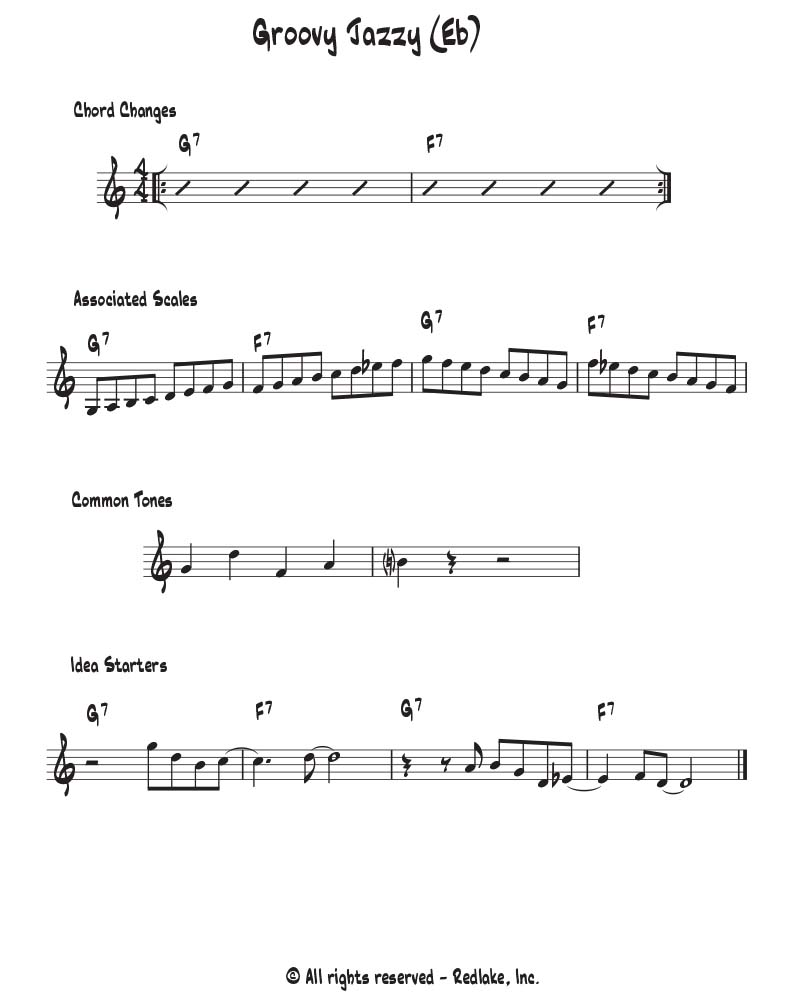
That's the thinking behind Groovz Playground.
Each Groovz track creates a musical environment built around one, two, three, or four chords. The harmony stays stable long enough for you to stop chasing the next chord and start listening within the sound.
The goal isn't to simplify music. It's to simplify the learning. There's an important difference. By removing unnecessary distractions, you're free to strengthen the one connection that matters most: the connection between what you hear and what you play.
When that connection becomes stronger, everything else becomes easier. Improvising over a tune no longer feels like solving a puzzle. You're bringing a more developed musical voice into a richer harmonic environment.
Closing the Distance
When Richie Beirach criticized matching chords to scales, he wasn't dismissing theory. He was describing what happens when years of listening, studying, practicing, and performing finally converge. That's the destination.
That's what we're after. We want our instrument to become such a natural extension of us that it simply plays what we hear.
Every scale you practice has a purpose. Every technical exercise has a purpose. Every hour you spend listening to great musicians, singing a phrase before you play it, simplifying the musical environment so you can truly listen, and strengthening the connection between your ear and your instrument is moving you toward the same goal. You're learning to make music before you simply learn to play it.
That journey never really ends. Even the greatest musicians continue listening, refining, discovering, and growing. They aren't trying to accumulate more information. They're continually narrowing the gap between what they imagine and what they can express.
The distance between hearing and playing is the distance every musician spends a lifetime closing.
Continue Your Journey
Foundation
What Is a Musical Ear?
What musicians really mean when they talk about having a good ear.
Read →Next step
Ear Training
Practical ways to strengthen the connection between what you hear and what you play.
Read →Go deeper
Where Musical Ideas Come From
How hearing musical ideas is the first step toward expressing them naturally.
Read →Put It Into Practice
Connecting what you hear with what you play requires focused listening, deliberate practice, and regular application. These resources will help you develop all three.