Learning Library
How Do I Learn to Hear the Chord Changes?
Hearing the changes isn't about naming chords. It's about feeling where they're pulling.
Michael Lake · 13 min read
You've heard it. Someone is comping through a tune, or soloing over it, and they clearly know exactly where the harmony is headed. Right now, in real time. Meanwhile you're reading the changes or at least concentrating about them as you play. And there's that time delay as you try to improvise fluidly from chord to chord and key to key. It's pace is halting because you're not instinctively anticipating what is coming.
Those other players just must know more than you. More chord types, faster name recognition, well-practiced argeggios, a bigger vocabulary. But that's not actually the difference. They're not identifying chords faster than you. They're feeling something you don't yet hear as well as you could or should.
Feel the Pull Yourself
Forget the chord names for a second. Play a C and an F# together on a keyboard. It's not a comfortable static sound, is it?. Those two notes don't want to just sit there. There's tension in it, like the sound itself wants to go somewhere.
Now move the F# up to G, and the C down to B, at the same time. Feel that? It settles. The tension resolves into something calm.
[Listening note placeholder—replace with instruction text.]
That's it. That's the whole idea this article is built on. You just heard the pull using two notes and two half-steps.
Nobody had to explain a chord symbol to you for you to hear it. The rension resolving into calm wasn't a theory concept. It was a emotional sensation, and it's the exact thing happening every time a dominant chord resolves to its root. Everything else in this article is built off that same sound, just wearing more colorful clothes.
The Same Pull, Hiding in Every Key
This is not just a neat trick or a one-time event. It's the same shape, over and over, just transposed to a different key.
Play G7 moving to C. Inside that G7 are a B and an F. Move them the same way. The F drops to E, the B rises to C, and you land on the calm sound of a C chord. Same pull, same shape, different notes.
Try A7 moving to D. Inside the A7, there's a C# and a G. Move them the same way, and they resolve into D and F#.
Play through those moving intervals a couple of times at a piano or guitar so you can hear it. Every dominant chord you come across possesses this same little piece of gravity inside it aiming at wherever it's about to land. You don't have to think about the resolution. It's already built into the physics of the chord, waiting for you to hear it.
Root Movement: The Outer Layer of Pull
Once you feel that two-note pull, zoom out. That pull is the engine, and the bass note provides the destination. Once you strip away everything except the roots moving underneath those two notes on top, you can feel the motion of the harmony, well before you hear the resolution.
Try this with a tune you already know. Ignore the melody completely and just follow the bass line. Notice the roots aren't just moving randomly. They're moving toward something, the same way the F# was leaning toward G.
The guide tones create the pull. The root tells you the destination.
Anticipating Instead of Reacting
Once you can hear that pull, you stop waiting for the next chord to hit before you respond to it. You can anticipate it. You feel the F# leaning toward G before it resolves, and once you can hear that tension in real time, you start playing into the resolution instead of catching up to it after the fact.
That's the instinct that separates a player who's leading the tune's form from one who's just following it. Leading means you're building your lightning-fast reaction to the pull of harmonic tension. You're just not waiting for the next chord to tell you what to play, you're anticipating it.
Proving It to Yourself: Outlining Changes Alone
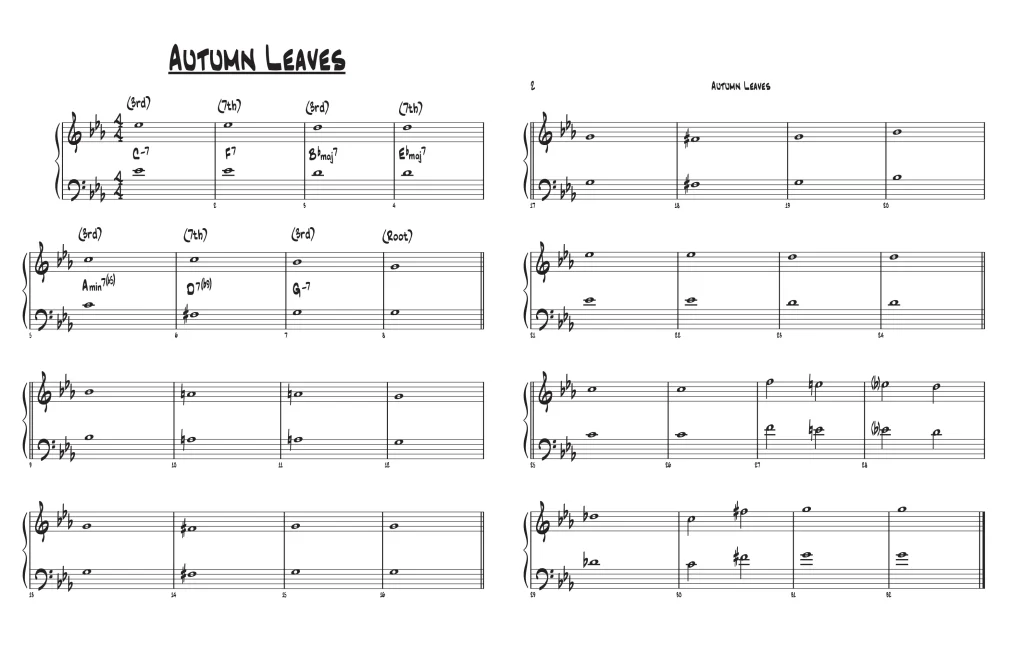
Here's the real test. Take a tune you know, and play through its guide tones—the notes doing the pulling, its thirds and sevenths—through its cadences and turnarounds. Emphasize those. Use the lead sheet chords to help you find the thirds and sevenths if you need to but your goal is to eventually hear them without reading.
Hearing It in Motion
This is easier to hear than to theorize, so here's the pull in action. I recorded one chorus lightly improvising over "Autumn Leaves", which is a tune that's almost nothing but the kind of motion this whole article has been describing. Four-bar stretches of tension building and releasing. One gravitational pull after another. A demo about fundamental flow, not about complex lines.
Listen for the moments where a note holds still, then leans, then lands. None of it is about how many notes fit into a bar. It's about whether you can feel the change coming before it arrives, and let that feeling shape the direction of your phrases.
One caveat: Everything in this piece describes one common way jazz harmony works. How the chords build tension and resolve it through the pull of tritones within the ii-V-I. It's the backbone of an enormous number of standards, and once you can feel it, you'll hear it almost everywhere, including all through "Autumn Leaves." But it's not the only harmonic movement in jazz.
Some tunes still use that pull but send it somewhere you wouldn't predict. The bridge to "Have You Met Miss Jones?" is a famous example. Each phrase still resolves with the same tension-and-release you just learned to hear, but the bridge keeps landing in unrelated keys instead of the ones your ear expects. And some tunes don't use this kind of pull at all. "So What", "Impressions", "Little Sunflower", and many others barely change chords in the traditional sense. They sit on a chord or mode for extended lengths, and then go to a different chord or mode. There's no tension being set up, so while there is movement, there's no gravitational pull that you hear needing to be resolved.
None of that undoes what you just learned. Feeling the pull will serve you in a lot of tunes. But it's one tool, not the whole toolbox. And the tunes that don't follow these rules are worth their own article down the road.
Hearing changes was never about knowing more chord names than the next player or calling out a chord name once it's played. Those aren't bad things to know, but it's a physical sense of pull that will guide your ear and therefore motivate the musical phrases of your improvisation.
For now, go find a tune you already know well enough to play without the chart. Find a tritone in the V7 chord. And instead of naming it, just listen to where it wants to go.
Let your ear guide your playing rather than your intellect.
Continue Your Journey
Related article
Why Do I Lose My Place in the Form?
Hearing the pull lets you anticipate the form instead of following it—a deeper kind of knowing than tracking chord names.
Read →Related article
Connecting Your Ear to Your Instrument
Ear training isn't a separate subject. It's the connection between what you hear and what you play.
Read →Related article
Hear It Before You Play It
Why the gap between imagination and performance matters—and how your ear can lead before your fingers catch up.
Read →