Softcover · PDF · Audiobook · Kindle
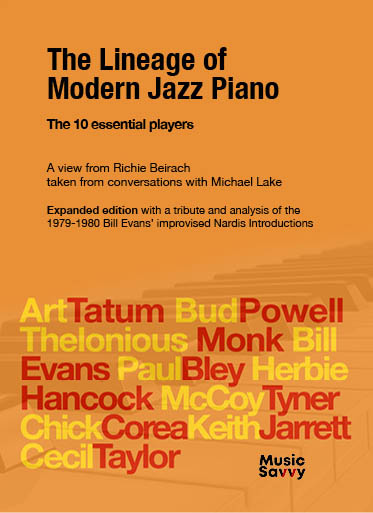
10 pianists. 120 years of jazz. One master's view.
What if one of jazz's most respected pianists sat down and told you exactly who shaped modern jazz piano — and why? That's this book. Richie Beirach's firsthand account of the 10 pianists who defined the lineage of modern jazz — told in his own words, from a lifetime spent inside the music.
Softcover · PDF · Audiobook · Kindle · From $9.95
"Richie is one of the great explainers of difficult concepts that can be understood both in academia and on the street."

Dave Liebman
Grammy-nominated Jazz Saxophonist & Educator
The Essential Lineage
The 10 Pianists Who Shaped Modern Jazz
Richie chose these ten not because they are his personal favorites, but because each one had an indispensable role in the continuum of modern jazz piano. Here is his list — and why it matters.
Art Tatum
1909 – 1956
"There's a recording of him called Piano Starts Here — which is literally true. Modern jazz piano started there."
Bud Powell
1924 – 1966
"Bud set a precedent — a level of pianistic brilliance, creativity, and fire that has rarely been equaled."
Thelonious Monk
1917 – 1982
"Monk was a genius within his own world. He created his own language that you could hear a mile away."
Bill Evans
1929 – 1980
"What he brought to jazz piano was incalculably important. Bill was my hero."
Paul Bley
1932 – 2016
"No one had ever played like that. Without Paul Bley there wouldn't be all those players after him."
Herbie Hancock
b. 1940
"Probably the most swinging and most elegant jazz pianist who ever lived."
McCoy Tyner
1938 – 2020
"McCoy is on the Mount Rushmore of jazz piano players. He is absolutely essential."
Chick Corea
1941 – 2021
"In my opinion the hippest piano player in the world at that time — young, strong, brilliant, and forward looking."
Keith Jarrett
b. 1945
"At his best he was fundamentally important to the history of jazz."
Cecil Taylor
1929 – 2018
"He was a real living renaissance man. Cecil was kind of the end of the line in terms of where modern jazz piano started with Art Tatum."
Why This Book
Why You'll Love This Book
Deep Historical Insights. Understand jazz piano evolution through a clear and compelling narrative — not a textbook, but a master's firsthand account.
Personal Stories & Anecdotes. Richie knew many of these pianists personally. Experience jazz history vividly through his firsthand stories and memories.
Educational Resource. Ideal for teachers and students seeking inspiration, analysis, and deeper jazz understanding — with recommended recordings for each pianist.
Expert Perspectives. Gain valuable musical and philosophical insights directly from a master pianist who has spent his life at the highest levels of this music.
Enhanced Appreciation. Transform your listening experience by understanding the innovations within the music — and why each pianist changed everything that came after.
From the Pages
Richie's Voice — Unfiltered
This book reads the way Richie talks — direct, opinionated, and deeply felt. Here are two examples.
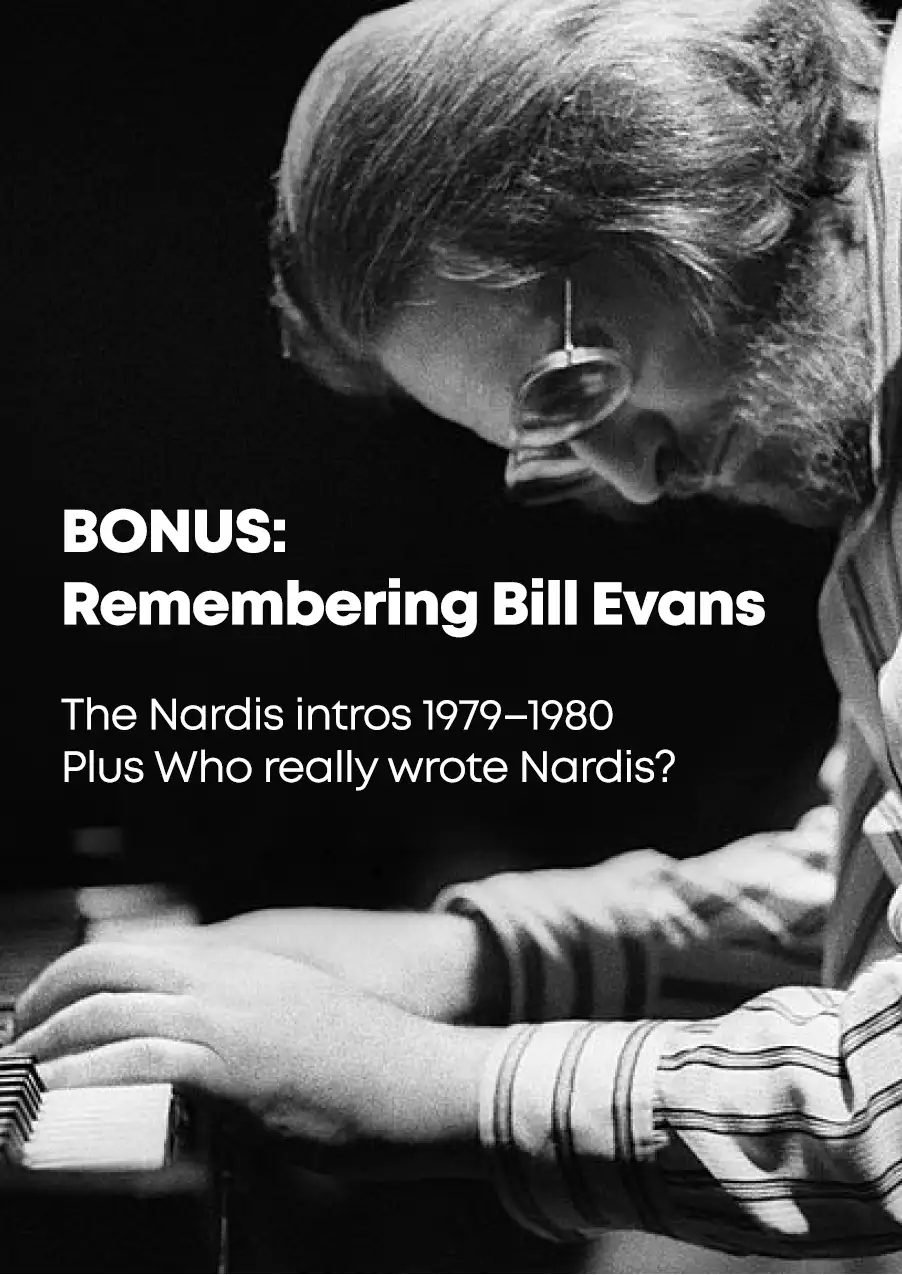
The Bonus Bill Evans Section — On Nardis
Richie knew Bill Evans personally in his final years, and the Bill Evans chapter is the longest and most intimate in the book. The expanded edition includes Richie's deep dive into Nardis — the tune that became the defining statement of Bill's final period.
- Who actually wrote Nardis? The tune is credited to Miles Davis — but Richie makes a compelling case, from personal knowledge, that Bill Evans wrote it.
- The improvised intros — in his final trio with Mark Johnson and Joe LaBarbera, Bill developed increasingly adventurous, deeply personal introductions to Nardis that became a world of their own.
- A different musical language — Richie describes how Bill came up with an entirely new harmonic and melodic vocabulary specifically in the context of these Nardis intros.
- Personal insight — Richie watched this unfold firsthand, and his account brings you inside one of the most fascinating creative developments in late Bill Evans.
"I know in my heart that Bill wrote Nardis, not Miles. Bill came up with this other language in the context of the introduction to Nardis." — Richie Beirach, p. 18
On Thelonious Monk — p. 12
Monk had a mastery of composition and he knew what he wanted to play. But let's just say that the technique that was required to play what he heard was not involved. He played very few lines. He didn't synchronize his lines with the bass and the drums like Bud Powell did and many of the other great bebop piano players. That's okay. He didn't have to because his compositional influence was so strong.
— Richie Beirach, p. 12
Hear Richie
Where this book began
This is the opening five minutes of the first conversation between Richie Beirach and Michael Lake — the conversation that started it all.
Why these ten pianists — and not others.
In this excerpt, Richie explains the reasoning behind his choices. Why Art Tatum and not Oscar Peterson? Why Thelonious Monk and not Lennie Tristano? What makes a pianist "essential to the lineage" rather than simply great?
Richie's answers are direct, opinionated, and illuminating — exactly the voice that makes this book so compelling.
Note: Richie mentions Lennie Tristano in this early conversation. He later replaced Tristano with Thelonious Monk for the final book.
Get the Book
Choose Your Preferred Format
Available in multiple formats to match your reading style.
Softcover Book
Highlight, bookmark, and keep it close at hand.
$19.95PDF Edition
Instant digital download for tablets and computers.
$9.95Audiobook
Listen anytime, anywhere.
$9.95 Buy Audiobook
Free ebook of Richie's Great Art & Commercial Success with your purchase of audiobook.
Read It Risk-Free
If The Lineage of Modern Jazz Piano doesn't deepen your understanding and appreciation of jazz piano — and make you want to pull out your headphones and listen to every record mentioned — contact us for a full refund. No questions asked.
And you keep the book.
Questions you might be asking yourself.
Richie Beirach is a jazz piano giant. He recorded two albums (Elm and Hubris) for ECM at the time Keith Jarrett and Chick were also ECM artists.
Richie was also a great educator, having taught at the Mendelssohn School in Leipzig, Germany for 15 years. Richie was the most passionate person I've ever met. And that passion fueled his hunger for understanding and applying a vast knowledge of music — jazz and other styles. Just ask him anything about 20th Century classical music.
This was the first of what would turn out to be several books and short form writing we would do together. Think of me as the interviewer and producer of our public work.
No. Richie writes the way he talks — directly and without unnecessary jargon. The book is accessible to anyone who loves jazz and wants to understand it more deeply. Jazz educators, beginning jazz musicians, and advanced musicians will find it equally valuable for its musical insight and recommended listening.
It's neither. It reads more like a long, illuminating conversation with a master. Richie shares opinions, personal stories, and deep musical insight — but it never becomes dry or academic. Dave Liebman captured it well: it can be understood "both in academia and on the street."
Richie is clear that these 10 were chosen specifically for their role in the historical lineage and their innovations — not because they are his personal favorites or the "best." The book also includes a full section of "Other Pianists of Note" acknowledging many of the greats who didn't make the essential 10. It's a deliberate, reasoned argument — and if you listen to the audio above, you'll hear Richie explain exactly why each one is included.
If the book doesn't exceed your expectations, contact us for a full refund — no questions asked. You keep the book regardless.
120 years of jazz piano.
One book. One master's view.
The Lineage of Modern Jazz Piano gives you a deeper relationship with the music — told by someone who lived inside it.
From $9.95 · Softcover · PDF · Audiobook · Kindle