Groovz Playground
A play-along method for strengthening your improvisation
Improvisation feels best when it’s natural, when you sync with the rhythm and melodies simply flow. Groovz Playground is your space to explore that freedom.
Forget endless scales and complicated theory. These tracks are designed to sharpen your ears, spark creativity, and build confidence in your own musical voice.
Don’t be intimidated by the one-chord loops—they’re often the most challenging. The two-, three-, and four-chord loops become progressively easier. Come in, play, listen, and discover what’s possible.
Not sure where to start? Choose your mood…

What do you feel like?
Choose a mood and get a Groovz Playground play-along track to practice your improvisation. Click "Open this full exercise" to find the scales, chords, and other lesson components that will help you best play over this. But first, choose the mood.
Mood
Includes chord changes, scales, common tones, and idea starters.
v1.8.0

Single Chord
Beat Sweeper
This upbeat track sticks to a single chord—Bb7—but the organ pushes outside with chromatic comping. Use that freedom to explore all 12 notes, aiming to resolve to Bb7, and lean on the “strong tones” to shape clear phrases, even at a faster tempo.
Spy Versus Spy
This track stays on a C minor chord, which means you’ll need to create interest through rhythm and phrasing, not harmonic movement. Use the natural minor scale, vary your timing, and focus on shaping phrases that tell a mysterious story.
Dreaming of Mars
This track uses static suspended harmony in C, giving you room to explore both major and minor colors—including lydian. With no defined tempo and no chord movement, the challenge is in shaping interest through phrasing, tone, and subtle variation.
Contemplation
This track stays in the key of C major, even though the bass and harmony move every four bars. Rather than chasing every change, focus on the overall sound and use a few key scale shapes to build your ideas.
Sound Refuge
Rooted in E major, this track offers space to explore without the pressure of tempo. Use the E mixolydian and major pentatonic scales, and focus on tone, phrasing, and note length to find musical direction in this rich, static setting.
Cruisin’
This one’s fast, but it’s just Bb7 the whole way. Listen to the guitar for rhythmic ideas, and rather than filling space with eighth-note lines, try using longer notes and syncopation to shape your phrasing.
Two-Chord Loops
Breeze Easy
This is a simple C major to D minor loop—all white keys. Use the space to play what you hear, not just what fits; wider intervals and clear melodic contour will help your lines feel more musical.
Suspended Reality
This progression creates a suspended, unresolved feel. Don’t overthink the theory—listen to the harmony, find melodic paths through both chords, and let your ear lead the way.
Subsurface Silence
This progression creates a suspended, unresolved feel. Don’t overthink the theory—listen to the harmony, find melodic paths through both chords, and let your ear lead the way.
Endless Horizon
This 3/4 groove moves between two chords a fifth apart, creating a looping, open-ended feel. Most notes work over both chords—try repeating simple ideas and notice how their character shifts with the harmony.
Southside Strut
Classic two-chord guitar funk with plenty of room to stretch. Start with Mixolydian or blues scales, but don’t stop there—this groove welcomes color tones, tension notes, and anything with some attitude.
Bailey’s Walk
A jazz waltz shifting between Dmaj7 and Cmaj7—a whole step apart with few shared tones. Use restraint with the tonic and listen for how C is used sparingly in the idea starter.
Eleuthera
A slow two-chord pattern over the A major scale, inviting a relaxed, melodic approach. Let your ear guide you to the right chord tones—don’t run scales, tell a story.
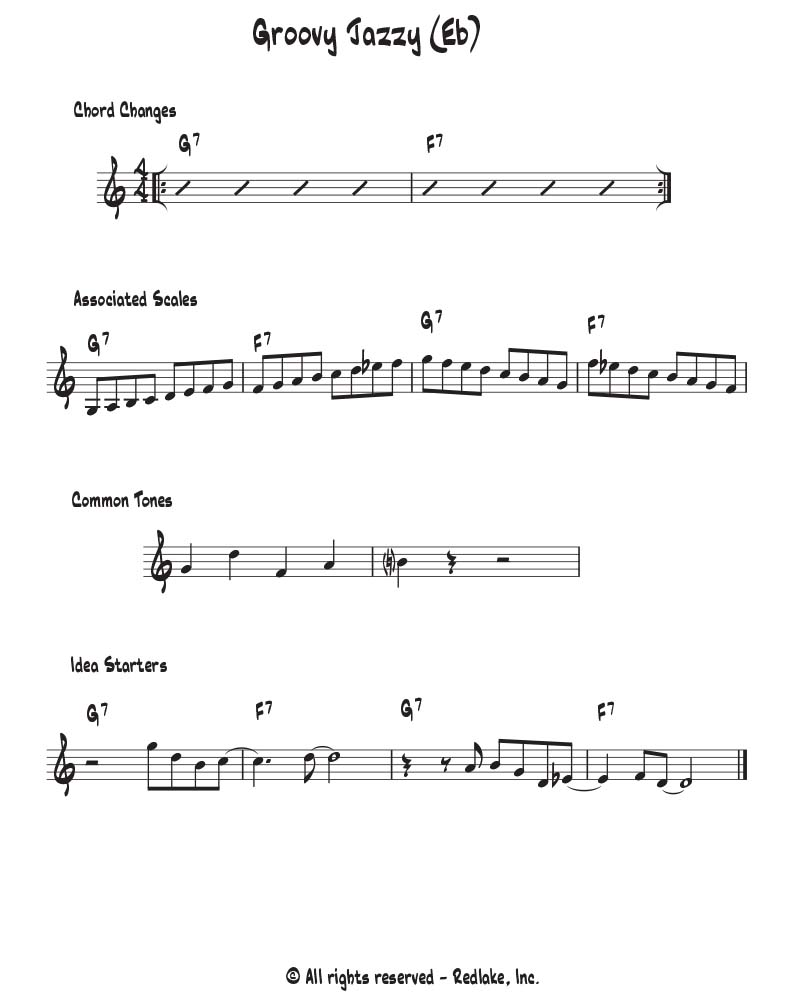
Groovy Jazzy
This medium swing groove alternates between Bb7 and Ab7, just a whole step apart. Focus on shared tones like D natural, which functions as the 3rd of Bb7 and the sharp 11 of Ab7, to help connect your ideas smoothly.
Standing Outside
This groove moves quickly between major and minor chords with the same root, so there’s no time to overthink—just listen and respond. Focus on the shared tones and build lines that wrap around the rhythmic patterns from the bells and vocals.
Jungle Dance
A cinematic-feeling groove with two simple chords and shared tones. Don’t rush—use those common tones to spark your phrases as you settle into the rhythm.
Island Mines
This slow groove moves between A minor and F major using the C major scale. Instead of running scales, focus on shaping melodies and developing phrases over time.
Afternoon Daydreaming
Two chords just a half step apart—one major 7th, one dominant 7th—with only two common tones between them. It’s a samba, so keep the rhythms playful. The Idea Starter may look fast, but the tempo is moderate. Great for practicing scale fluency and learning to shift your phrasing smoothly between contrasting harmonic colors.
Disco Marley
A quirky Reggae-ish groove switching between A and D major. Once you internalize the keys, the shared tones will help you shape creative, flowing lines.
Lush Life vamp
This is a funk vamp built on the opening bridge changes of Lush Life. The challenge is in how different the two chords are, but a few good common tones will help connect your lines. Don’t think in two-bar chunks—listen, and hear how the chords relate.
Earthen Choir
A slow, open track inspired by Garbarek’s work with the Hilliard Ensemble. Use the common tones to shape lyrical, connected lines as the choir flows in and out.
Galactica
Forget just “playing the right notes”—this track is about expressive phrasing that fits the cinematic mood. Use the Idea Starter as a launching pad, then try swapping its fragments or creating your own variations. Lots going on here—layer your lines into the swirling voices and let your phrases cut through.
Three-Chord Loops
St. Thomas Block Party
This tropical groove uses a simple I–IV progression in C major. Every note in the scale fits, but the trick is landing smoothly from one chord to the next. Party on!
The Benji Pad
A simple two-chord drone in A♭ major. The second chord adds a D natural, but you can just treat it like A♭ major with a twist. Stay in three flats—easy and smooth.
Summer’s Dawn
A relaxed jazz waltz using three chords in a looping progression. It’s trickier than it looks—watch out for the E♭, which works for F7 but not the rest. Use the shared tones to guide your ideas, and try out the “blue note” for flavor.
Four Chord Loops
Sails Full Open
These three chords may seem tricky, but they’re easier than they look. Just watch out for the B♭—it only works in certain spots. Use the concert C freely and other shared tones to add color and variation.
Spinning Top
This "infinite loop" groove uses three major seventh chords in 3/4 time with no harmonic resolution. Use the shared tones to weave simple, melodic lines through the shifting chords. Pentatonics work well—keep it lyrical.
Milky Way
These four chords look trickier than they are. A C natural minor scale or C minor pentatonic will get you through most of it. Just watch how certain tones, like F, clash or resolve depending on the context.
Caribbean Express
If you like salsa, this groove’s for you. Focus on rhythm—lock into the downbeats and syncopated off-beats. Use short, repeating phrases and vary them slightly, just like salsa dancers do. Keep it deliberate and danceable.
I-VI-II-V Progression
For this classic progression, the sixth stays in the key to make improvising easier. Stick with the G major scale, but notice which tones sound best—especially how the tonic often isn’t the strongest choice.
Dawn of a New Day
This groove uses the G major scale over shifting bass notes. The #11 (F#) over C gives it flavor—but don’t just run scales. Listen closely and aim for musical phrases shaped by the flowing harmony.
Inception
Inspired by Hans Zimmer’s theme from Inception, this four-bar loop blends simple triads with a building seventh chord. A few common tones will help guide you, but your ear will need to do most of the work to shape strong melodic lines.