Stop running scales. Start making music. Those two simple sentences are front and center on my home page for a reason.
I’m reminded of those two lines when I listen to less experienced or less skilled jazz players and when reviewing many of the submissions to The Loft (a review platform where I give free feedback to players submitting a sample of their playing.)

Major and minor second intervals make up the bulk of this type of playing. And what are made up of those intervals? Scales. And it’s easy to understand why. Narrower intervals are easier to play and to ‘hear’.
But there is another reason: for the past several decades, jazz education has taught players to associate a scale to a chord. Play D Dorian over D minor 7, G Mixolydian over G7, and C major scale over C major 7. Easy peasy.
The problem with that method is that it replaces the musician’s ear with his analytical brain. Instead of following an internal musical intuition, and the connection between ear and instrument, the player is instructed to use a complicated association to find the scale or scale lick/pattern. The result is an non-melodic rollercoaster ride of major and minor seconds.
Run this experiment
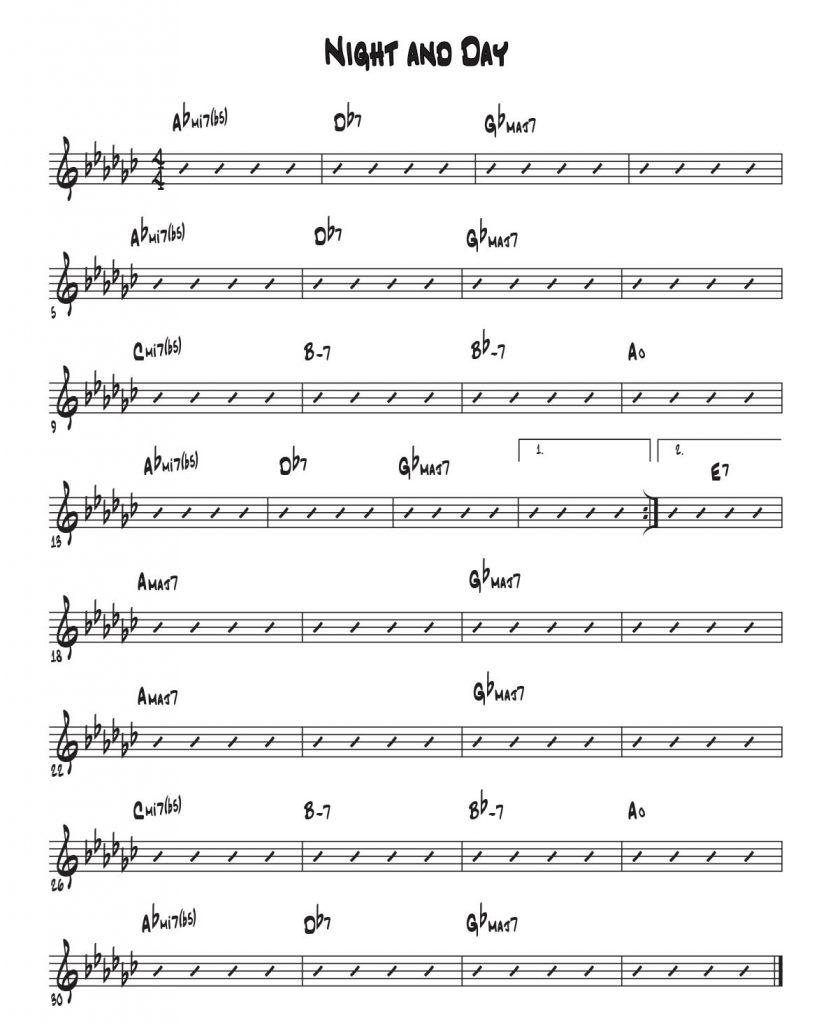
Look at the following lead sheet for the standard tune Night and Day. I’ve purposefully put it into the key of Gb. Look at the chords and see how fast you can translate that into scales – many of which are not intuitive because they are outside of scales and modes you typical spend time on.
How well can you make music from that? How free are your ears to hear and interact with the rhythm section? Probably not very well.
The next part of this experiment is to listen to the rhythm section playing in this same key. Without thinking about the names of the key and chords, play your instrument and find notes and then phrases that sound good over the track.
How did you do? Could you resist thinking, “What’s a good note to play over Gb major ?” “What scale do I play over Ab half diminished?” Well, you are not alone, because you’ve probably been trained to think primarily in terms of scales not sound.
My lines “Stop running scales. Start making music.” is not a shaming statement. It is my admonishment to open your ears and truly improvise.
You’re thinking, that’s all fine but I need a starting point to know where to even begin playing over changes. So, let me give you a better starting point.
Play the rhythm track of Night and Day without your instrument. Instead, sing, scat, or hum some improvisation over it. I bet you aren’t singing scales as much. You are probably singing a few wider intervals and even some more interesting musical phrases. I know you’re not thinking what scale is played over Db7!
If you do this experiment and actually hear the gap between what you play on your instrument and what you sing as a reflection of your musical imagination is precisely the gap Music Savvy trains you to bridge. I call it the mind to instrument connection.
Bridging that connection is the secret to improvising jazz (or any style) with grace, musicality, and satisfaction. You start playing music that your listener can follow and appreciate.
But it does require you to loosen your tight grasp on scale thinking and safety of major and minor intervals.
Watch this video I posted recently to TikTok (one of my more popular videos). I demonstrate the result of improvising by playing scales over Autumn Leaves. I then contrast that with ear-lead phrases using wider intervals over the same track.
I had to think a lot harder to play the scales version. For the melodic version, I simply sat back and played what I heard inside.
Yes, I know that’s easier said than done, but improvisation (spontaneously composing music in real time) is not an easy task. It takes years/decades of practice and of playing ‘wrong’ notes to play at a music level.
But if you’re going to practice this art form, shouldn’t you start practicing in a way that will result in you performing more musically?
Ok, if you want to quickly sound like you’re improvising, stick to scales. It’s much safer, quicker, and easier. “Impress your friends. Look, I can play jazz!”
Excuse my sarcasm, but it truly makes me sad that so many well-intened musicians have been lead down the dead-end path of replacing their ear with eyes and medlody with scales.
If you would like a method of training your ears and of connecting ear to instrument, join the Jazz Circle It is a monthly subscription that uploacks everything within Music Savvy: the video courses, the books, the exercises, the play-along tracks, the video snippets and full interviews I produced with great players, and inspiration. There’s even a custom curriculum builder called Navigator that will point you in the right direction through all of the Music Savvy Library. And at least submit a sample of your playing to The Loft and see what constructive feedback I can give you for free!
So please stop playing scales and start making music!
Start sounding like you.
The best jazz has always come from the inside out from the blues, from raw emotion, from a personal voice. But too many players are trading their authentic musical soul for a library of borrowed licks and rote scale patterns.
Subscribe to The Jazz Circle monthly membership to access the entire Music Savvy Library of lessons, exercises, books, videos, and inspiration training you to improvise from your ear, not scales or memorized licks. The Music Savvy primacy-of-ear method is designed to help you find your own sound, not reproduce someone else's.