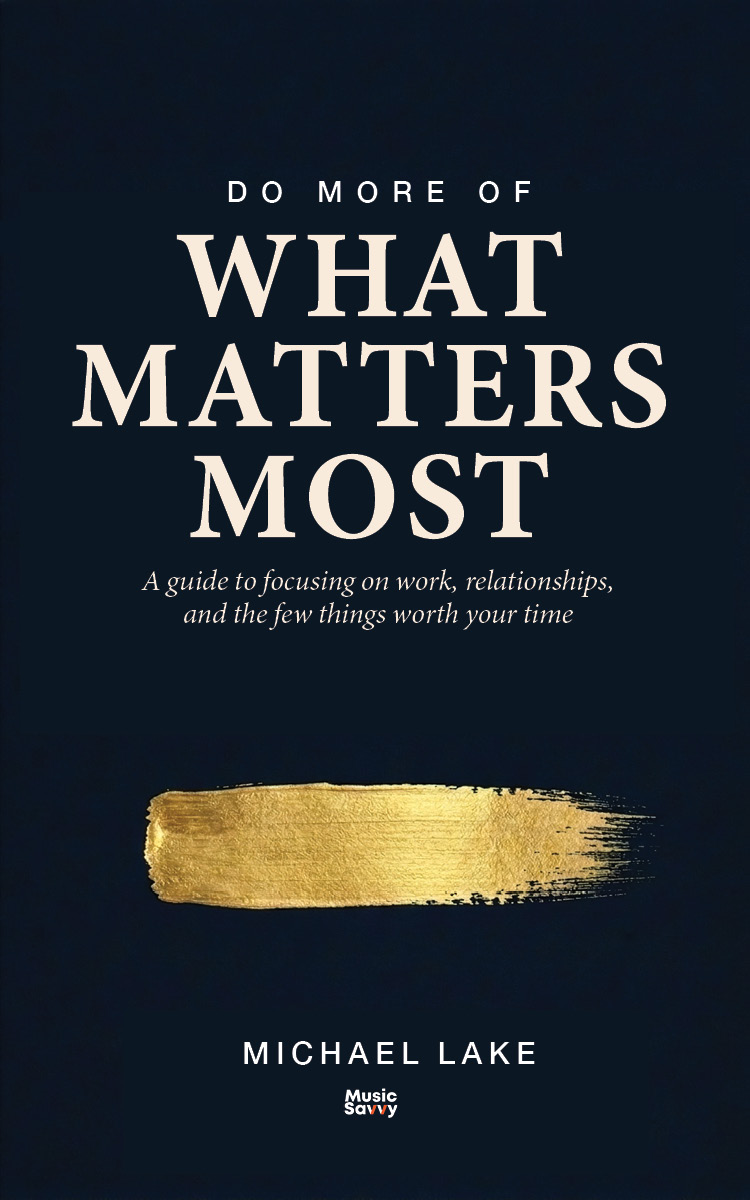
I’m recording my new book on focus, Do More of What Matters Most, for its audiobook. Speaking it out loud, then editing the audio, gives me a different perspective on the ideas. I just finished chapter 7, “Who You Are Becoming,” and it’s one of my favorite chapters because it speaks to what I think is the most important timescale of focus: not just today’s task, but who you’re becoming over a lifetime.
Living true to your identity isn’t a bumper sticker. It’s how you actually spend your time, what you stay with when it’s hard, and what you quietly refuse to walk away from. When those choices line up with who you say you are, focus stops being a self-help project and starts being the way you move through your day and life.
We hear “be true to yourself” so often it’s basically background noise now. It shows up in commencement speeches, Instagram posts, and casual advice when someone’s stuck. The problem is, almost nobody talks about what that actually requires. If you’re not clear about your real values or you keep ignoring them in favor of whatever’s fun and easy in the moment, “being yourself” just means following your moods. You can feel authentic while you’re burning hours on things that don’t serve your true values or your long-term needs.
The version of identity I most care about is a lot more practical. It’s not a brand, a label, or a mood. It’s the person you’ve actually decided to be, expressed in how you treat your time, your work, and your promises. If you tell me you’re a serious musician, I’m going to listen to your practicing and look at your calendar, not see how hip your Spotify playlist is. If you say your family is your top value, I’m going to look at how often you’re fully present with them, not how often you post about them.
Here’s the simple rule I use, and it’s all over my thinking and this book: how you do one thing is how you do most things. If you’re the kind of person who leaves things half-finished, that shows up in your inbox, your body, your relationships, and your projects. If you’re the kind of person who respects time and gets things genuinely done, that pattern follows you around too. You can call yourself anything you like; your pattern will tell the truth.
Most people think they have a focus problem. I don’t buy that. What they usually have is a clearly identifies values problem. They’ve never really sat down and asked, “What matters to me enough that I’m willing to be uncomfortable for it?” If you don’t know that, then of course your attention is for sale to the loudest and most fun thing in the room: your phone, your email, somebody else’s emergency. You’ll bounce from tab to tab, feel guilty about not focusing, and then try to fix it with hacks, apps, and timers. It might help for a week. It won’t stick. It’s not real.
Everything changes when you get honest about what you value. Not in a vague, aspirational way, but in very specific terms. For me, that list includes things like:
Keeping my trombone playing at a professional level, not “I used to play.”
Staying healthy enough to keep working and playing for a long time. That includes one live-food meal a day, vigorous movement, and constantly challenging my mind.
Doing work that actually functions well for Music Savvy and my clients, not patched-together messes that explode later.
I don’t pretend those should be your values. But they are mine, and you can see them in how I live. That’s the point. Your values shouldn’t match mine. They should be real enough that they reflect you in your behavior, day after day and year after year.
Once you’re clear on your own values, focus stops being abstract and difficult. It becomes a very simple question: does this thing in front of me serve what I value, or not? If it does, it deserves your attention. If it doesn’t, it goes in the “noise” bucket. You don’t need a ten-step system for that. You need a backbone.
This is where the philosophical side comes in. You are the author of your life, responsible for your choices and for the values you pursue. That responsibility doesn’t stop at big ideas or public debates; it reaches all the way down into whether you stay with a stubborn problem until it’s actually fixed, or slap on a band-aid and call it a day. When something matters and it’s broken, my default is simple: address it in the order of priority it deserves and don’t stop until it’s really fixed from root cause, not cosmetics. That attitude has carried me through debugging sessions that went nowhere for hours, practicing when I didn’t feel like it, and finishing projects long after the fun part was over (including the tedious recording and editing of this audiobook!)
People romanticize focus as flow: time disappears, everything feels great, and you look up surprised at how much you got done. I love those days. But some of the most important work in my life has looked nothing like that. It was me, at the wall, frustrated, not seeing much progress, choosing not to quit. That second kind of focus, the fix-it focus, is pure identity. You stay not because it’s fun, but because walking away would contradict who you say you are. You are compromising on the work and relationships you claim to care about.
So when I talk about “living true to your identity,” I’m not saying “follow every impulse.” I’m saying: decide who you are, based on what you genuinely value, and then let your daily choices be votes for that person. Every time you come back to a hard project instead of abandoning it, you’re voting for being someone who finishes what matters. Every time you’re fully present on a date instead of half-scrolling under the table, you’re voting for being someone who gives the people you care about your actual attention. Over time, those votes add up. That’s building your true identity.
Focus, in my world, is just the visible trail those votes leave behind. If your calendar is full of time spent on things you don’t care about, that’s not a focus problem. That’s a you living a story that isn’t really yours problem. If, slowly, your days start to fill with work, people, and moments that actually matter to you, you’ll notice something: staying with them gets easier, or as I like to say, “inevitable.” Saying no to the rest is less like discipline and more like self-respect.
You don’t have to rebuild your whole life overnight. You don’t need a retreat or a new app. You can start small: name three things that truly matter at this stage of your life, and give one of them a real block of attention today. That one block of fully present, no hunting for exits effort is you living a little closer to your real identity. Do that repeatedly, and the line between who you say you are and how you actually live starts to disappear. That’s the point: do more of what matters, on purpose, as the person you’ve decided to be.